
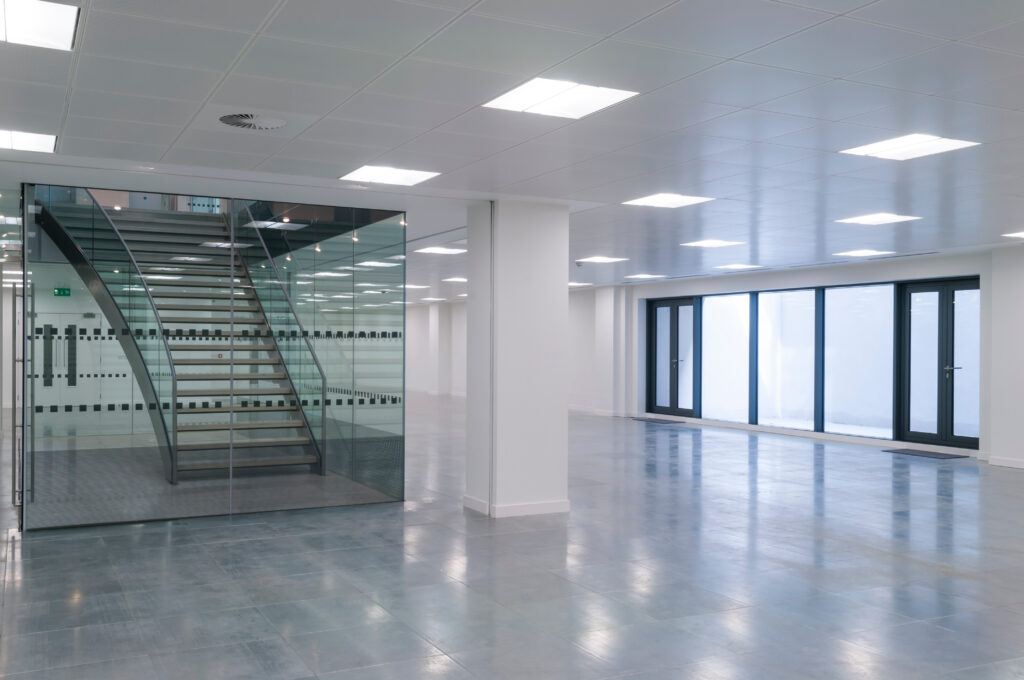
You walk into your lobby on a Monday morning and the floor looks tired. Not dirty, because the nightly crew mops it, but dull and gray in the walk paths. One vendor says it needs a full strip and wax. Another says a burnish will bring the shine back for a fraction of the price. Who’s right? The answer comes down to whether you actually need to strip and wax floors or just polish what is already there.
Here’s the short answer. If the finish on your floor is intact and just scuffed or hazy, burnishing or a scrub and recoat will restore it. You only need to strip and wax floors when the finish itself has failed: yellowed, worn through to bare tile in the traffic lanes, or so layered with old wax that it looks muddy no matter how you polish it. Stripping is the most aggressive, most expensive option, and a good commercial floor care program treats it as a last resort.
This guide explains what each process does, which floors each one applies to, and how often high-traffic offices across Georgia should burnish, recoat, and strip and wax floors. If you’d rather talk through your building’s commercial floor care needs directly, Riddley Commercial Cleaning offers free consultations for facility and office managers from its home base in Kennesaw to metro Atlanta and beyond. A quick walk-through, a straight answer, no pressure.
Despite the name, there’s no actual wax involved anymore. Modern “wax” is an acrylic floor finish applied in thin coats that cure into a hard, glossy, sacrificial layer. Foot traffic, grit, and cleaning chemicals wear down that layer instead of your tile. When it is gone, you strip and wax floors and start the cycle over.
A full strip and wax starts over from bare tile. The crew applies a chemical stripper that dissolves every layer of old finish, agitates it with a low-speed machine, wet-vacuums the slurry, rinses and neutralizes the tile, then lays down three to five fresh coats with drying time between each. A mid-sized office takes a night, sometimes two, and the floor stays off-limits while the finish hardens. That’s why crews strip and wax floors after hours or over a weekend.
Two lighter commercial floor care services sit between routine mopping and the decision to strip and wax floors:
A smart commercial floor care program layers these so you rarely need the full strip. Every year you don’t have to strip and wax floors is money back in the budget.
These words get used interchangeably, but they’re different machines doing different jobs. Buffing uses a rotary machine under 1,000 rpm to clean scuffs and restore a moderate shine. Burnishing runs at 1,500 to 3,000 rpm, generating enough friction to slightly melt and re-harden the top of the finish for that wet-look, mirror gloss you see in well-kept lobbies.
Burnishing high traffic areas weekly or biweekly does two things at once: it keeps the shine up, and it re-hardens the finish so it resists scuffs longer. The catch is that burnishing high traffic floors only works on a finish designed to respond to it, and only when there’s enough finish left to polish. Burnish a worn-through floor and you’re grinding heat into bare tile. At that point you strip and wax floors instead.
For office floors, grit is the enemy that decides your schedule. Whether your building sits in Marietta, Midtown Atlanta, Lawrenceville, or Cartersville, Georgia adds its own abrasives: red clay tracked in on wet days, spring pine pollen, and construction dust from the development that never seems to stop around the metro. Every particle acts like sandpaper under shoes, which is why walk-off mats and daily dust mopping extend your finish more than any machine work. Grit control is the cheapest way to strip and wax floors less often.
This is the single most expensive mistake in commercial floor care, so it’s worth two minutes of your attention.
VCT (vinyl composition tile) is the classic 12-inch square commercial tile with a speckled pattern that runs all the way through. It’s porous and ships from the factory almost unprotected, so it needs finish to survive. VCT is the floor you strip and wax.
LVT (luxury vinyl tile or plank) is the newer product, often printed to look like wood or stone. It has a factory urethane wear layer and is designed to never be stripped or waxed. Aggressive strippers and high-speed burnishing can cloud or destroy that wear layer permanently. LVT needs neutral-pH cleaning and periodic machine scrubbing, nothing more. You never strip and wax floors like these.
Plenty of renovated Georgia offices have both: LVT in the lobby, original VCT in the break room and storage areas. A good provider identifies each floor type on the walk-through and treats them differently. If a vendor quotes one price to strip and wax floors throughout the building without asking what they are, keep looking.
There’s no single right interval, but traffic gives you a reliable starting point for VCT:
The finish will tell you when to move the schedule up. Yellowing, gray traffic lanes where tile shows through, a muddy look that burnishing won’t cure, and flaking edges all mean recoating is no longer enough. Catch those signs early and each recoat resets the clock cheaply. Miss them and you’re paying for the full strip. The whole point of a schedule is that you strip and wax floors on your terms rather than the floor’s.
Industry groups like ISSA, the worldwide cleaning industry association, publish time and task standards crews use to plan this kind of maintenance, one reason a structured commercial floor care program beats calling someone only when the floor looks bad.
Stripping is wet, smelly work that closes the area for hours, so timing matters as much as technique. Schedule full strips for a Friday night or long weekend so the finish cures before Monday’s foot traffic. Book recoats for a single overnight, and keep burnishing on a recurring after-hours calendar. Ask your provider to ventilate during stripping and use low-odor products, especially with shared HVAC. Good scheduling is most of what makes it tolerable to strip and wax floors in an occupied building.
This is where a local, flexible janitorial service pays off. Riddley Commercial Cleaning is a family-owned janitorial company based in Kennesaw, with more than 60 years of combined experience serving offices across metro Atlanta, all of Georgia, and the broader Southeast. The team works around your hours, and hard floor cleaning is built into its office cleaning programs. For office floors that see hundreds of visitors a week, one crew handling both the daily mopping and the periodic machine work means nothing gets skipped.
Plan on one overnight for a small office, up to a full weekend for large or heavily layered floors. Light foot traffic is fine a few hours after the last coat, but the finish keeps hardening, so furniture, rolling chairs, and burnishing high traffic lanes should wait a few days.
No. LVT’s factory wear layer isn’t designed for high-speed burnishing, and the heat can permanently cloud it. If your LVT looks dull, it needs a proper neutral clean and machine scrub. If it’s scratched through the wear layer, that’s a replacement conversation, not a polishing one.
Usually, yes, as long as it happens before the finish wears through. Regular recoating on sound finish lets busy offices stretch full strips to 18 months instead of 6. Once bare tile shows in the walk lanes, though, a strip is the honest fix, and that’s the moment to strip and wax floors and reset.
The difference between a floor care program and a floor care emergency is mostly timing. Burnish and recoat on schedule and your VCT stays sharp for years between strips. Wait until the traffic lanes go gray and you’re buying the most expensive service on the menu. Nobody wants to strip and wax floors more often than they have to.
If you manage an office anywhere Riddley serves, from Kennesaw and Marietta to Atlanta, Decatur, and Lawrenceville, and you aren’t sure which side of that line your floors are on, reach out to Riddley Commercial Cleaning for a free consultation. You’ll get an honest read on what your floors are, what they need, and a schedule that fits your building’s hours. Just a plan for floors you never have to think about again.

Jim Raps is the President and CEO of Riddley Commercial Cleaning, a family owned and operated janitorial company headquartered in Kennesaw, Georgia. Riddley’s roots go back to the 1970s on the New Jersey Shore, where the family got its start cleaning local businesses and waxing floors. Today the company serves clients across Georgia and Tennessee, from healthcare facilities to financial services firms, with commercial cleaning, office cleaning, janitorial services, porter services, and electrostatic disinfecting. Jim and his team draw on more than 60 years of combined industry experience and are committed to doing the right thing for clients through hard work and old-fashioned values, backing every job with a satisfaction guarantee. As the company’s motto puts it, you don’t know diddly until you call Riddley.